Pretty-print / formatting
A long flat query is hard to read:
author.name = "Lem" and written >= 1960 and (genre = "scifi" or genre = "novel")
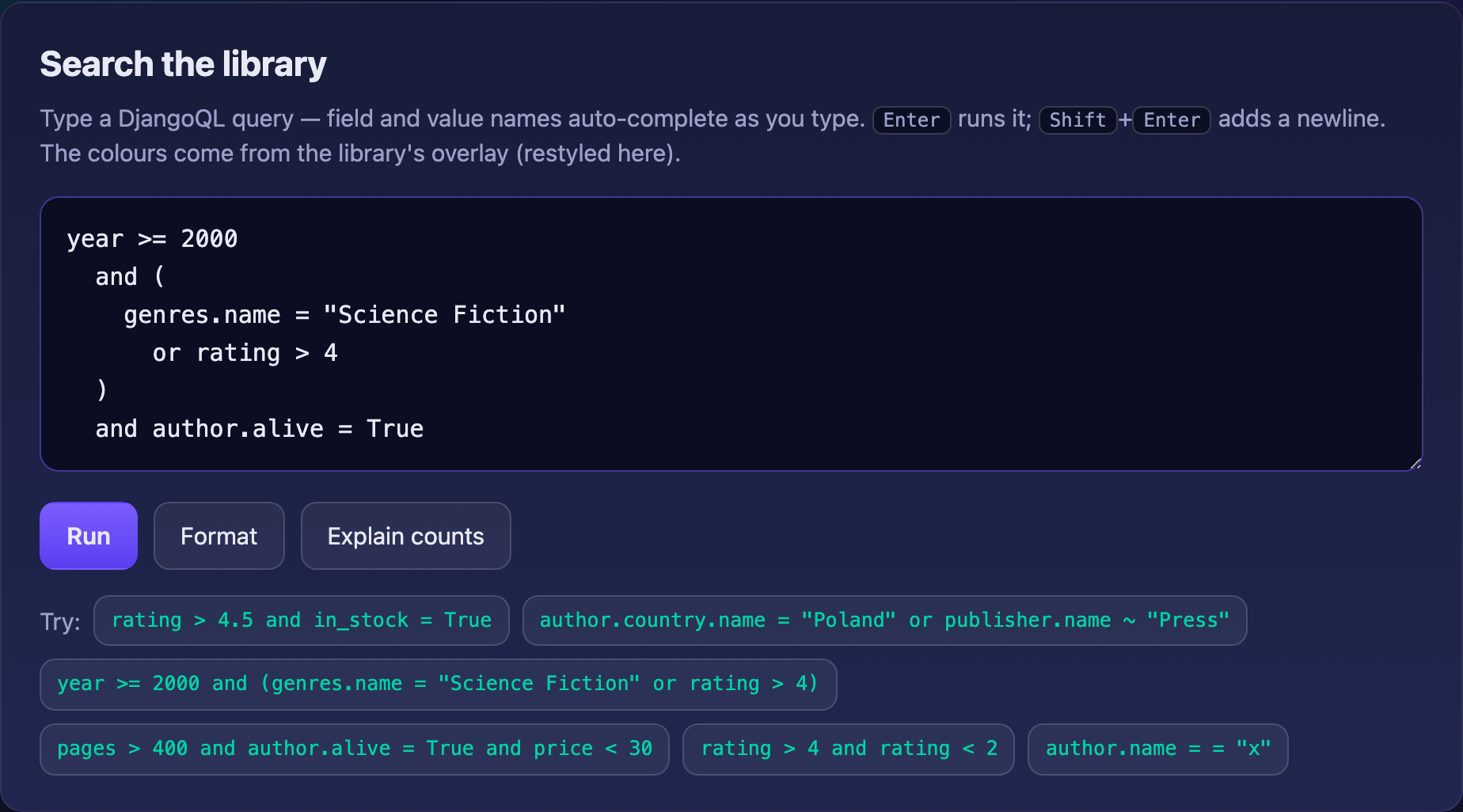
DjangoQL can re-render it as indented, multi-line text:
author.name = "Lem"
  and written >= 1960
  and (
    genre = "scifi"
      or genre = "novel"
  )
This is a pure, AST-driven transformation: the query is parsed and rendered back. Re-parsing the formatted text yields an equal AST, and formatting is idempotent (formatting an already-formatted query changes nothing).
Library primitive: format_query
from djangoql.formatter import format_query

format_query('a = 1 and b = 2')
# 'a = 1\n  and b = 2'

format_query('a = 1 and b = 2', indent=4)   # spaces per level (default 2)
# 'a = 1\n    and b = 2'
format_query needs no database and no schema — it only parses. A query that
does not parse raises djangoql.exceptions.DjangoQLParserError.
There is also serialize_node(node) for the compact, single-line canonical
form of an AST node (logical children parenthesised, leaves not). The
empty-result breakdown reuses it for its node labels.
from djangoql.formatter import serialize_node
from djangoql.parser import DjangoQLParser

serialize_node(DjangoQLParser().parse('(a = 1 and b = 2) or c = 3'))
# '(a = 1 and b = 2) or c = 3'
Admin endpoint
DjangoQLSearchMixin exposes a …/format/ endpoint (URL name
<app>_<model>_djangoql_format). It accepts the raw query as q (GET or POST)
and returns JSON:
{ "formatted": "a = 1\n and b = 2" }
An unparseable query returns {"error": "..."} with HTTP 400. This is the
primitive a front-end "Format" button calls when it has no JavaScript parser of
its own.
Wiring the button is your decision
The library ships the endpoint, not a button. Whether to add a "Format"
control, where to place it, and how it looks is the integrator's choice. See
the example_project/ for one reference implementation (a Format button next
to a multi-line query box).
How parentheses are handled
The parser drops redundant parentheses ((a) parses to a) and stores
and/or as a right-associative tree, so source parentheses are not preserved
verbatim. The formatter adds back exactly the parentheses needed to keep the
meaning — a nested logical group of a different operator is wrapped and laid out
as an indented block. Same-operator chains (a and b and c) are flattened to a
flat list of lines.
See also: Multi-line queries (Shift+Enter to type the newlines a formatted query contains).